
Contents
Overview
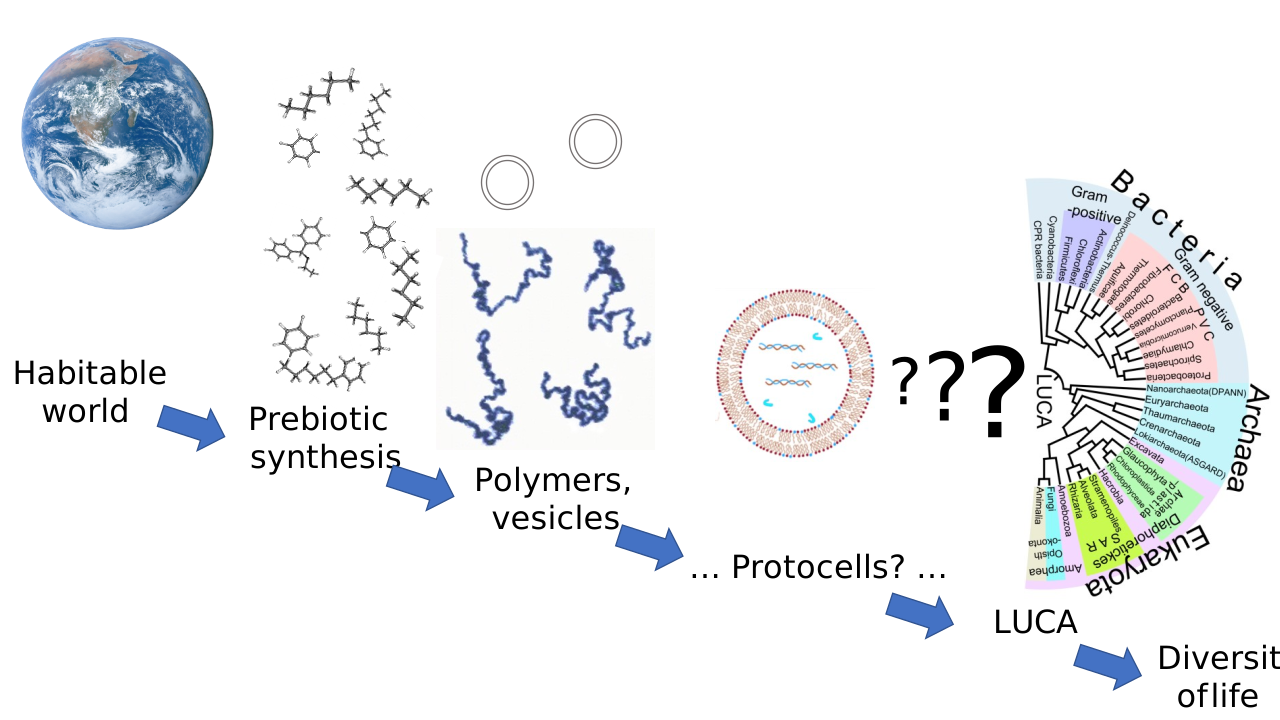
Abiogenesis, also known as the origin of life or biopoiesis, is the natural process by which life arises from non-living matter, such as simple organic compounds. This complex process involves the formation of a habitable planet, prebiotic synthesis of organic molecules, molecular self-replication, self-assembly, autocatalysis, and the emergence of cell membranes. With a rich history of scientific inquiry, abiogenesis has been studied by prominent researchers like Stanley Miller and Harold Urey, who have shed light on the possible mechanisms underlying this phenomenon. The study of abiogenesis aims to determine how pre-life chemical reactions gave rise to life under conditions strikingly different from those on Earth today, using tools from biology, chemistry, and other sciences. As a fundamental concept in the fields of astrobiology and the origins of life, abiogenesis continues to fascinate scientists and the general public alike, with its implications for our understanding of the universe and our place within it. Recent advances in fields like astrobiology and synthetic biology have further expanded our knowledge of abiogenesis, and have sparked new areas of research and debate. The search for life beyond Earth, such as on Mars or Europa, has also been influenced by our understanding of abiogenesis, and has led to new missions and discoveries that continue to shape our understanding of the origins of life.
🌎 Origins & History
The concept of abiogenesis has been debated for centuries, with ancient Greek philosophers like Aristotle proposing that life could arise from non-living matter. However, it wasn't until the 19th century that the scientific community began to seriously explore this idea, with the work of scientists like Louis Pasteur and Charles Darwin. The discovery of DNA and the development of molecular biology in the 20th century further accelerated research into abiogenesis, with scientists like James Watson and Francis Crick making significant contributions to our understanding of the origins of life.
⚙️ How It Works
Abiogenesis is a complex process that involves the formation of a habitable planet, the prebiotic synthesis of organic molecules, molecular self-replication, self-assembly, autocatalysis, and the emergence of cell membranes. The exact mechanisms underlying abiogenesis are still not fully understood, but scientists have proposed a number of theories, including the primordial soup hypothesis and the iron-sulfur world theory. The RNA world hypothesis is another theory that suggests that RNA molecules played a central role in the origins of life.
📊 Key Facts & Numbers
Some key facts and numbers related to abiogenesis include the fact that the building blocks of life, such as amino acids and nucleotides, can be found in meteorites and in interstellar space. The discovery of extremophiles, organisms that can survive in extreme environments, has also expanded our understanding of the conditions under which life can arise. For example, the deep-sea vent ecosystem is home to a diverse array of microorganisms that can survive in extreme temperatures and pressures. The Origin of Life Initiative at Harvard University is a major center for research into abiogenesis, and has brought together scientists from a range of disciplines to study the origins of life.
👥 Key People & Organizations
Key people and organizations involved in the study of abiogenesis include the National Science Foundation, the National Institutes of Health, and the European Space Agency. Scientists like Stanley Miller and Harold Urey have made significant contributions to our understanding of abiogenesis, and have paved the way for future research in this field. The Search for Extraterrestrial Intelligence (SETI) is also an active area of research, with scientists using a range of techniques to search for signs of life beyond Earth.
🌍 Cultural Impact & Influence
Abiogenesis has had a significant cultural impact and influence, with many scientists and philosophers exploring its implications for our understanding of the universe and our place within it. The search for life beyond Earth, such as on Mars or Europa, has also been influenced by our understanding of abiogenesis, and has led to new missions and discoveries that continue to shape our understanding of the origins of life. The concept of abiogenesis has also been explored in science fiction, with authors like Arthur C. Clarke and Carl Sagan using it as a theme in their work.
⚡ Current State & Latest Developments
The current state of research into abiogenesis is highly active, with scientists using a range of techniques, including molecular biology, geochemistry, and astrophysics, to study the origins of life. Recent advances in fields like astrobiology and synthetic biology have further expanded our knowledge of abiogenesis, and have sparked new areas of research and debate. The discovery of exoplanets and the development of new technologies for detecting life have raised hopes that we may soon be able to detect life beyond Earth.
🤔 Controversies & Debates
There are several controversies and debates surrounding abiogenesis, including the question of whether life is unique to Earth or whether it can be found elsewhere in the universe. Richard Dawkins argued that the origins of life are a purely natural process. The debate over the origins of life is ongoing, with scientists continuing to explore new theories and hypotheses.
🔮 Future Outlook & Predictions
The future outlook for research into abiogenesis is highly promising, with scientists expecting to make significant advances in the coming years. The development of new technologies, such as CRISPR and gene editing, is expected to revolutionize our understanding of the origins of life, and may even allow us to create new forms of life in the laboratory. The search for life beyond Earth is also expected to continue, with scientists using a range of techniques to detect signs of life on other planets.
💡 Practical Applications
Abiogenesis has a number of practical applications, including the development of new technologies for detecting life, such as biosensors and lab-on-a-chip devices. The study of abiogenesis has also led to a greater understanding of the origins of life on Earth, and has raised hopes that we may soon be able to detect life beyond our planet. The concept of abiogenesis has also been used in fields like biotechnology and pharmaceuticals, where scientists are using the principles of abiogenesis to develop new treatments and therapies.
Key Facts
- Category
- community-engagement
- Type
- topic